Master Plumber's Log · Published 2026-08-12
How to Tell If Your Delaware Home Has Polybutylene Pipes
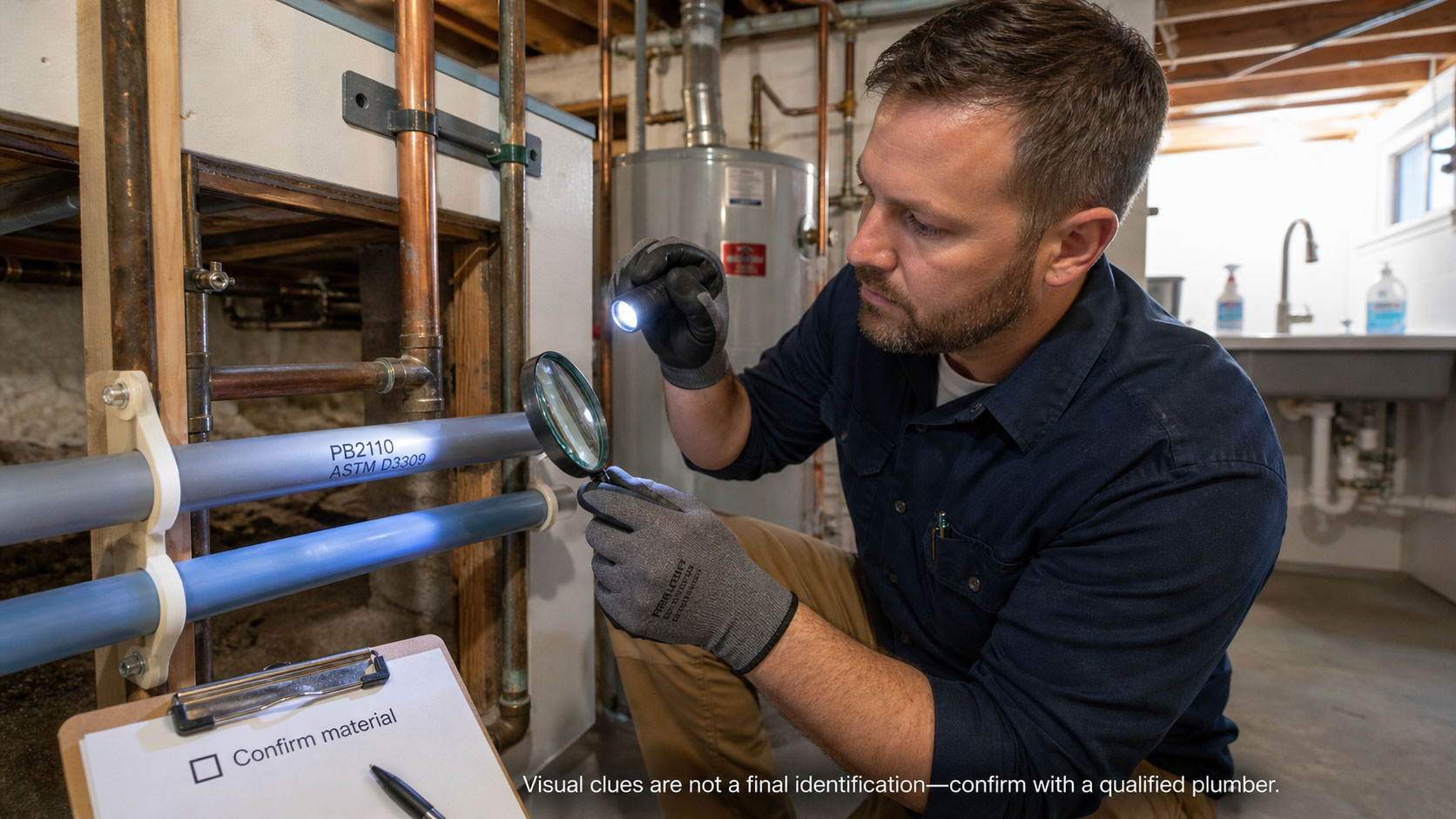
The short answer
Polybutylene (PB) supply pipe is usually gray, blue, or black, with a matte plastic finish and enough flexibility to bend by hand, and it’s typically marked with a stamped code such as “PB2110” repeated along its length. Look for it at the water heater, under kitchen and bathroom sinks, behind toilets, and where the main line enters the house. Color and location are useful starting points, but they aren’t a final answer—paint, dust, or a partial view can make identification uncertain, and much of a home’s supply piping runs inside walls, ceilings, and slabs where it can’t be seen at all. If your home was built or re-plumbed between 1978 and the mid-1990s, a plumber’s inspection is the reliable way to confirm what you have.
Visual identification checklist
Work through these checks in order. Any one of them can be enough to suspect PB; none of them alone can rule it out with certainty.
- Color. PB supply pipe is most often gray or black indoors and blue outdoors or at the water meter. Silver-gray is also common.
- Stamped markings. Look along the pipe’s length for a printed code—commonly “PB2110,” along with standard references like “ASTM D3309” or “AWWA C902/C904.” The stamp can be faint, painted over, or oriented away from view.
- Flexibility. PB pipe is noticeably flexible; it can be bent by hand in a way that copper and CPVC cannot, and it typically runs in continuous lengths with fewer joints than rigid pipe.
- Fittings. PB systems commonly used plastic or metal crimp-style fittings rather than the soldered joints seen on copper.
- Build or renovation date. Polybutylene was manufactured for plumbing use between 1978 and mid-1995, per the InterNACHI inspector reference, and installed in an estimated several million U.S. homes during that window. A home built, re-plumbed, or added onto in that period is worth checking even if no pipe is visible from the accessible areas.
Where to look
- At the water heater, where supply lines connect at the top.
- Under kitchen and bathroom sinks, where the shutoff valves and supply lines are usually visible.
- Behind toilets, at the shutoff valve and connector.
- At the main water entry point, in a basement, crawlspace, or utility closet.
- Outside, near the water meter or where the service line enters the foundation.
If you can see pipe in two or three of these locations and it matches the color and markings above, that’s a strong indicator—but confirm before assuming the entire house matches what you found in one spot. Some homes mix materials from past repairs.
Polybutylene vs. PEX, copper, and CPVC
| Material | Typical color | Flexibility | Common markings |
|---|---|---|---|
| Polybutylene (PB) | Gray, black, or blue | Flexible, bends by hand | ”PB2110” or similar stamped code |
| PEX | Red, blue, white, or gray | Flexible, similar feel to PB | ”PEX” plus an ASTM/CSA standard printed on the pipe |
| Copper | Copper/orange metallic | Rigid | No plastic stamp; may have a manufacturer mark |
| CPVC | Cream or off-white | Rigid | ”CPVC” plus a standard code printed on the pipe |
PB and PEX can look similar at a glance because both are flexible plastic pipe—color and the printed standard code are what tell them apart, not flexibility alone. If you’re not sure which flexible pipe you’re looking at, treat it as unconfirmed until a plumber checks the marking.
Why a visual check has limits
Most of a home’s supply piping isn’t visible. Runs inside finished walls, above ceilings, under slabs, or behind cabinetry can’t be inspected without opening a finish or using a camera. A visible section at the water heater or under a sink tells you about that section—it doesn’t confirm what material was used throughout the house, especially if the home has had partial repairs or additions over time. Paint, insulation sleeves, and dust can also obscure both color and stamped markings even where pipe is accessible.
Warning signs beyond a visual check
Even without seeing the pipe, some signs are worth an inspection:
- A home built or re-plumbed between 1978 and the mid-1990s.
- Discoloration, flaking, or a chalky texture on any visible plastic supply pipe.
- Small leaks at fittings that seem to recur in different spots over time.
- Disclosure paperwork or a prior inspection report that mentions polybutylene, even if you haven’t located it yourself.
None of these confirms polybutylene by itself, but any of them is a reasonable trigger to have a plumber take a closer look.
What to do after a visual check
A visual check is a starting point, not a diagnosis. The next step is a plumber’s inspection: checking accessible pipe for color and stamped markings, examining fittings, and noting where the material can’t be confirmed without opening a finish. From there, Spangler Plumbing’s polybutylene replacement service can outline what a repipe would involve for your specific home. If you’ve already confirmed polybutylene and want to understand what shapes a replacement quote, see what changes the cost of a Poly-B repipe.
Frequently asked questions
Is all gray plastic pipe polybutylene?
No. Gray is a common PB color, but some PEX and other plastic pipe can also appear gray or silver. Check for a stamped code before assuming the material based on color alone.
Can I identify polybutylene without cutting into a wall?
You can often identify it where it’s already visible—at the water heater, under sinks, behind toilets, or at the main entry point—without opening any finishes. Confirming pipe that runs inside walls or under a slab does require a plumber’s inspection, and sometimes camera equipment.
My home was built after 1995. Could it still have polybutylene?
It’s less likely, since manufacturing for plumbing use ended around mid-1995, but older polybutylene stock could have been installed shortly after, and re-plumbing during a renovation could have introduced or removed it at any point. If you’re unsure of your home’s plumbing history, a visual check is still worthwhile.
What should I do if I think I found polybutylene?
Note where you saw it and any markings you could read, then request an inspection. Spangler Plumbing can inspect the visible piping and outline next steps.
Does homeowners insurance cover polybutylene pipe failure?
Coverage varies by policy and carrier. Confirm with your insurance agent or carrier directly rather than assuming coverage either way.
Get a confirmed answer for your home
A color match and a location are a reasonable starting point, but a plumber’s inspection is what confirms polybutylene with certainty. Request an inspection or call 302-293-8008 to schedule one.